
 Image 1 of 1
Specialist Structural Void Detection Services Across London, the South East and the UK
Identify hidden voids, loss of support and internal defects before they become costly structural problems
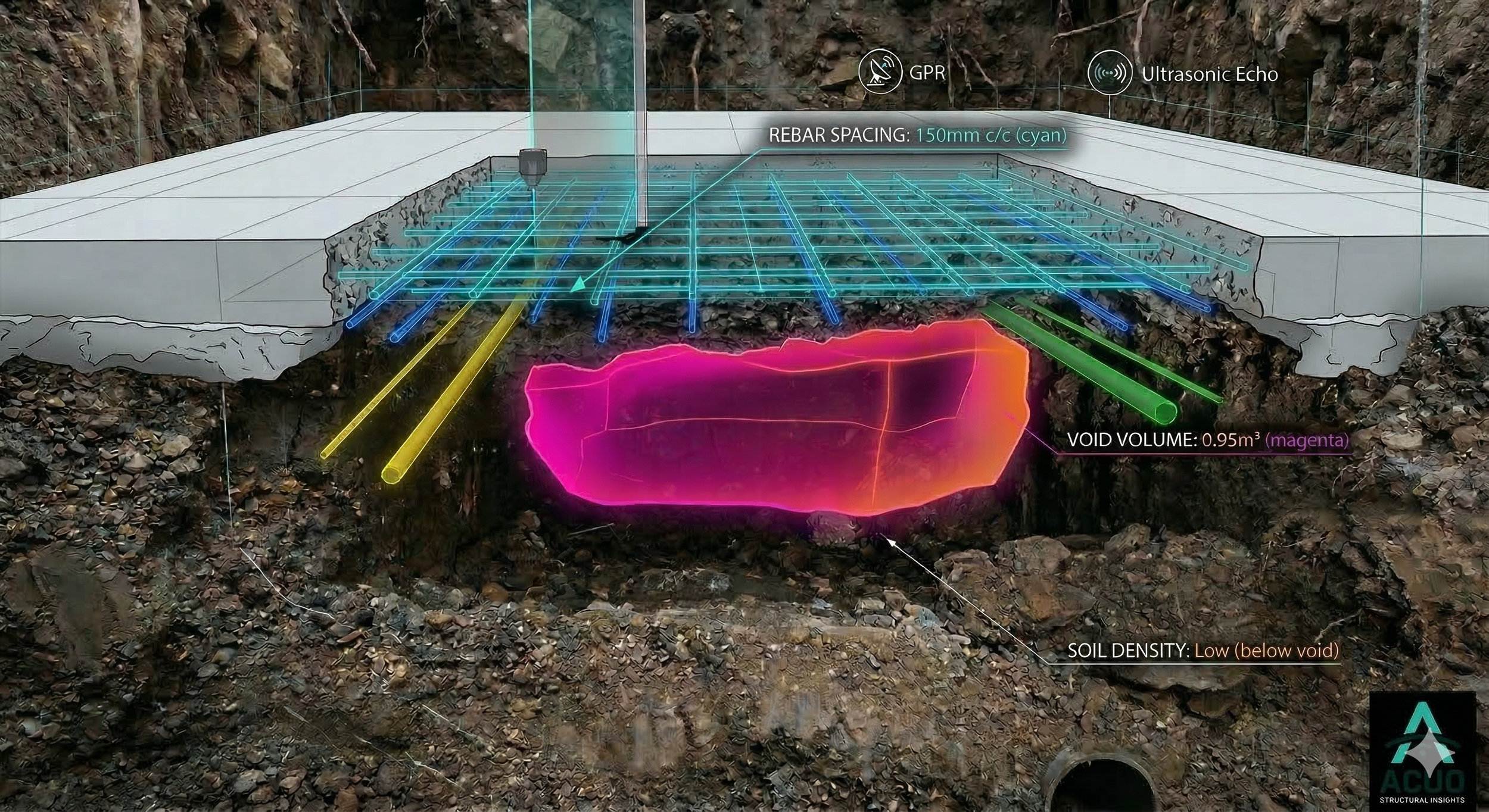
ACUO SI Ltd provides professional structural void detection services using advanced non-destructive testing (NDT) methods to investigate concealed defects beneath and within concrete structures. Hidden voids, delamination, honeycombing and areas of sub-base loss can significantly affect structural performance, particularly where slabs, bridge decks, suspended structures and load-bearing elements are subject to heavy use, water ingress or long-term deterioration.
Our investigations are designed to help contractors, engineers and asset owners understand whether unseen defects may be present before they develop into more serious safety, durability or serviceability issues. By locating potential voiding early, remedial works can be targeted more effectively, helping reduce risk, avoid unnecessary disruption and support informed engineering decisions.
Key Features
Detection of subsurface voids beneath concrete slabs and structural elements
Identification of delamination, honeycombing and internal anomalies
Assessment of loss of support and potential sub-base erosion
Investigation of concealed defects within slabs, bridge decks and foundations
Non-destructive testing to support repair and remediation planning
Targeted surveys to assist grouting and structural intervention strategies
Engineer-ready reporting with clear interpretation of findings
Suitable for commercial, industrial, infrastructure and asset management projects
What Our Structural Void Detection Services Provide
Structural void detection is used to identify hidden defects that cannot be seen from the surface but may affect the performance of a structure. These defects can include subsurface voids, air pockets, localised loss of support, delamination between layers, honeycombing within concrete, washout below slabs and internal anomalies caused by deterioration or construction defects.
Using advanced investigation techniques such as Ground Penetrating Radar (GPR) and other appropriate NDT methods where required, ACUO SI Ltd assesses the internal condition of structural elements and surrounding support zones. These surveys can be applied to a wide range of structures, including ground-bearing slabs, suspended slabs, bridge decks, parking structures, foundations, retaining elements and heavy-duty industrial floors.
Our services are particularly valuable where there are concerns relating to cracking, slab movement, settlement, hollow-sounding concrete, water ingress, loss of bearing support, or suspected deterioration beneath the surface. In these situations, accurate identification of the affected areas is critical so that repairs can be planned efficiently and unnecessary invasive investigation can be minimised.
Why Structural Void Detection is Important
Undetected voiding beneath or within concrete can lead to progressive deterioration, reduced load performance and, in severe cases, structural failure. Areas of unsupported slab can crack or deflect under loading, while moisture-filled voids can contribute to ongoing deterioration and accelerate reinforcement corrosion. Early detection helps project teams intervene before defects worsen, protecting both the structure and the wider project programme.
For contractors, this means better planning of repairs and less uncertainty on site. For engineers, it provides useful diagnostic information to support structural appraisal and remediation design. For clients and asset owners, it helps safeguard infrastructure, reduce long-term costs and improve confidence in asset condition.
Reporting and Site Support
All structural void detection works are supported by professional interpretation and clear engineer-ready reporting. Where required, outputs can be used to assist repair planning, targeted grouting strategies, further intrusive investigation planning and wider structural assessment.
ACUO SI Ltd combines practical site knowledge with advanced diagnostic technology to deliver clear, reliable and actionable data, helping clients identify hidden structural risks before they develop into more serious and costly failures.