
Uncovering the Deep: How We Mapped the Unknown at a Local Leisure Centre
Visualizing the Invisible: Leisure Centre Utility Mapping When a local leisure centre had absolutely no records of their underground drainage, they were flying blind. We stepped in to conduct a rigorous PAS 128 utility survey. See how we transformed complex underground data—including locating buried manholes and confirming combined flows—into a crystal-clear, professionally annotated CAD deliverable complete with integrated site photography. [View the Full Case Study & Deliverables]
When it comes to construction and development, what you can’t see can absolutely hurt your project. Hitting an unexpected underground utility can lead to massive delays, safety hazards, and budget-busting fines.
Recently, we were called to a local leisure centre facing a major roadblock: they were ready to move forward with a development project but had zero records of the existing underground drainage system. They were essentially flying blind, and they needed our help to shed some light on what lay beneath their feet.
The Danger of the Unknown
Imagine trying to navigate a maze in the pitch black. That is what planning a construction project without utility records feels like. For this leisure centre, the lack of confirmation regarding underground drainage was a significant risk.
Moving forward without accurate mapping meant risking strikes on vital sewer or stormwater lines. The client needed a definitive picture of the subterranean landscape before any ground could be broken, and they needed it quickly to keep their project timeline on track.
Our PAS 128 Solution
To eliminate the guesswork, our team deployed a comprehensive PAS 128 utility survey. The PAS 128 standard is the gold standard in our industry, ensuring the highest level of accuracy, reliability, and confidence in utility mapping.
Operating on a busy leisure centre site requires precision and efficiency. Here is how we tackled the challenge:
Advanced Tracing: We utilized specialized equipment to trace both conductive and non-conductive utilities across the survey boundary.
Physical Verification: We did not just rely on surface scanners; we physically located, lifted, and inspected manhole covers, including those that had been completely buried and forgotten over time.
Sonding the Lines: By deploying sonde transmitters directly through the drainage pipes, we were able to precisely track the route, depth, and connectivity of the underground network.
System Identification: We successfully confirmed the flow and type of the drainage, identifying crucial combined stormwater and sewer systems.
Delivering Clarity and Confidence
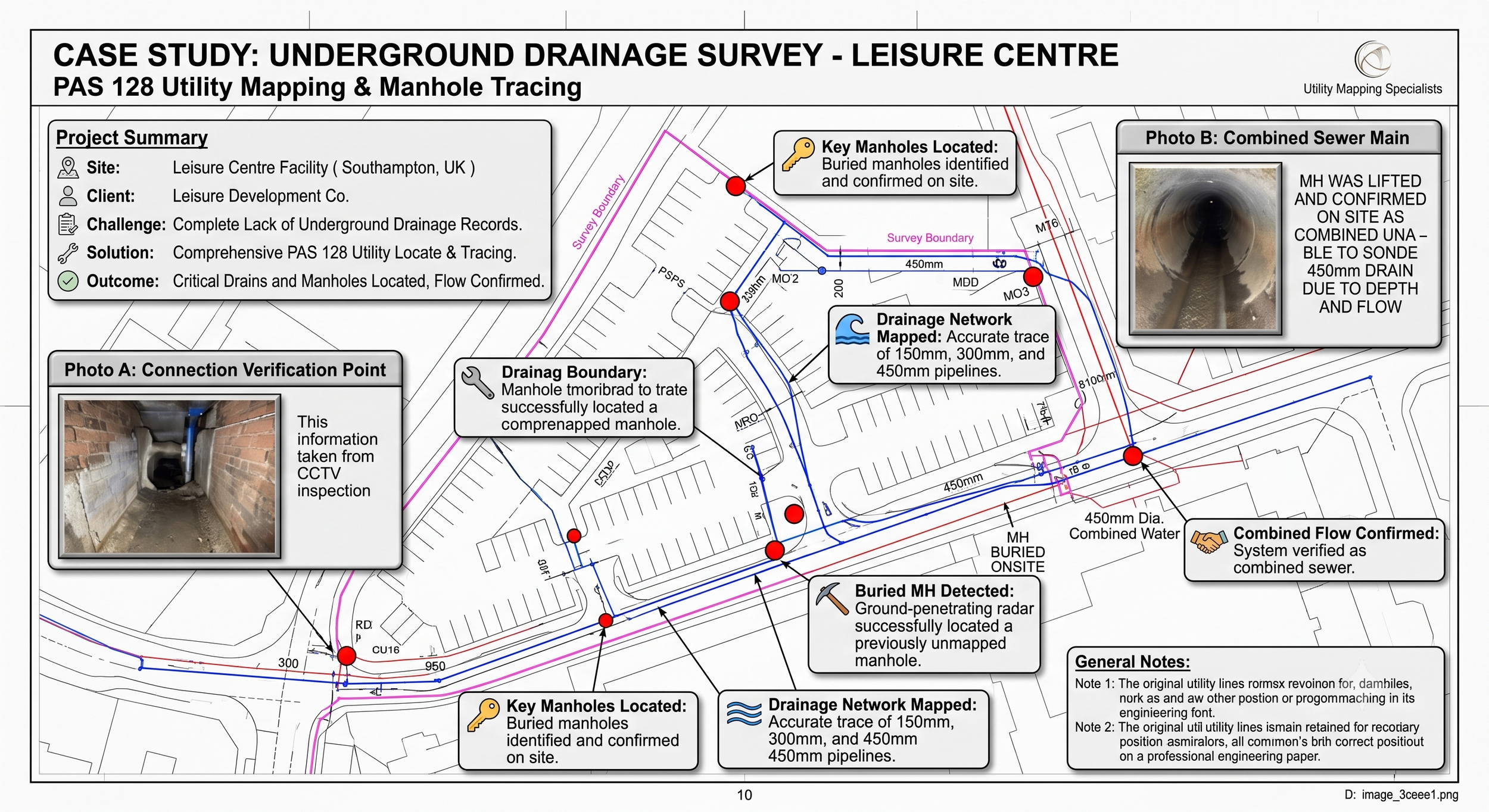
We transformed a total unknown into a fully documented, manageable asset. The culmination of our on-site work was a highly detailed topographic and utility CAD drawing (like the example in our project files, image_3c8981.png).
Our final deliverables provided the client with:
Precise Pipe Routing: Clear, color-coded lines detailing the exact path and depth of 150mm, 300mm, and 450mm diameter pipes.
Visual Proof: Real-time photographic evidence of the manhole interiors embedded directly into the CAD drawing for immediate context.
Crucial Context: Detailed annotations explaining site-specific challenges, such as buried connection points and confirmed drainage flows.
Moving Forward Safely
Armed with a definitive map of their underground infrastructure, our client was able to safely bypass utility conflicts, finalize their design plans, and confidently continue their project.
Underground mysteries don't have to stall your development. If you are facing a lack of utility records on your next site, a PAS 128 survey is your best insurance policy against the unknown.
5 Warning Signs Your Concrete Slab Has Subsurface Voids
5 Warning Signs Your Concrete Slab Has Subsurface Voids
You walk across your warehouse floor or driveway every day, but do you know what’s happening six inches beneath your feet?
Concrete is only as strong as the ground supporting it. When soil erodes, compacts poorly, or shifts due to water intrusion, it leaves behind subsurface voids—empty pockets of air that turn your solid slab into a structural bridge. Left unaddressed, these voids lead to "settlement," a polite term for your floor cracking and sinking.
Here are the top five early warning signs that your concrete is losing its foundation.
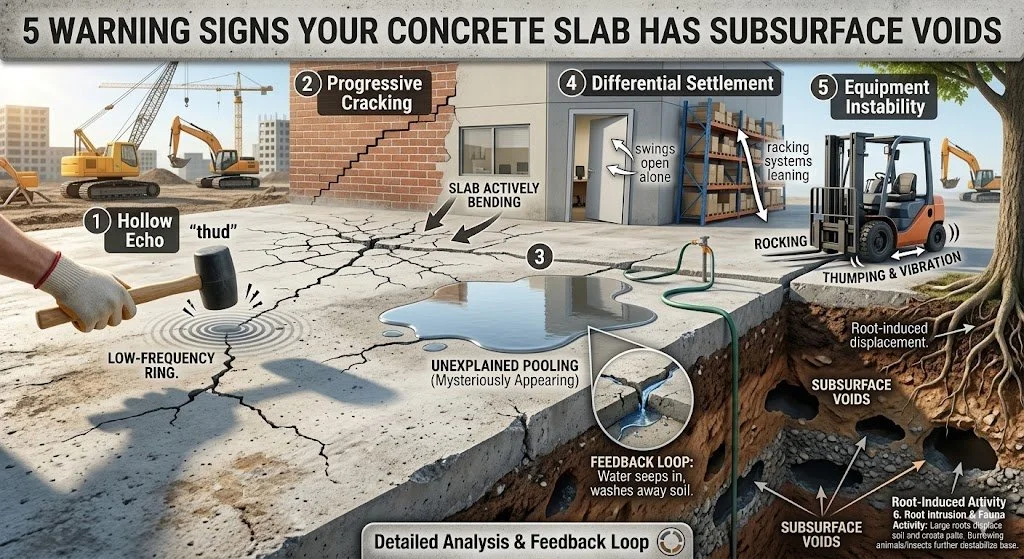
1. The "Hollow" Echo
The most literal sign of a void is the sound. If you notice a change in acoustics when walking, driving, or rolling equipment over a specific area, it’s likely a "hollow spot."
The Test: Use a rubber mallet or a heavy chain (the "chain drag" method) across the surface. A solid slab produces a high-pitched "thud," while a voided area will emit a distinct, low-frequency ring or echo.
2. Progressive "Spider-Web" or Stair-Step Cracking
Not all cracks are created equal. While hairline "shrinkage" cracks are common in new concrete, structural settlement cracks are different.
What to look for: Look for cracks that are wider at the top than the bottom, or "stair-step" patterns in nearby brickwork. If a crack continues to grow over weeks or months, it means the slab is actively bending into an underlying void.
3. Unexplained Water Pooling (Even Indoors)
If water is "mysteriously" appearing in the middle of a floor or pooling in areas that used to be level, your slab has already begun to tilt.
The Danger: In outdoor settings, pooling water often seeps into existing cracks, which washes away more soil, creating a "feedback loop" that accelerates void growth.
4. Difficulty with Doors, Windows, and Racking
In commercial and residential settings, the first sign of a void isn't always on the floor; it’s in the walls.
The Symptom: Are your warehouse racking systems starting to lean? Do office doors suddenly stick or "swing" open on their own? These are classic signs of differential settlement—where one part of the foundation is supported by soil and the other is hanging over a void.
5. Equipment Instability & Vibration
For industrial facilities, your forklifts are your best diagnostic tools.
The Red Flag: If forklift operators report "thumping" over joints or increased vibration in specific zones, the slab is likely "rocking" on a void. This doesn't just damage the concrete; it causes premature wear on your expensive machinery tires and suspension systems.
Don't Guess—Scan. Why GPR is the Solution.
In the past, the only way to confirm a void was "destructive testing"—drilling holes to see what was underneath. In 2026, we use Ground Penetrating Radar (GPR).
GPR allows us to see through the concrete in real-time, mapping the exact size, depth, and location of voids without a single drill bit touching your floor. This allows for targeted grouting, where you only fill the areas that actually need it, saving you thousands in repair costs.
Think you might have a void issue?
Don't wait for a collapse. [Contact our GPR team] for a non-destructive site assessment today.